If your child has ADHD, you’ve probably tried everything. Fidget toys, reward charts, different routines, maybe even medication. Some of it works. Some of it does not. But there is one thing that has been quietly gaining serious traction with doctors, therapists, and researchers, and it might surprise you.
Music lessons.
Not as a nice-to-have. Not as a fun after-school club. As an actual, evidence-backed way to help your child focus, regulate their emotions, and thrive, all while having a brilliant time.
Music isn’t just fun, it’s actual therapy
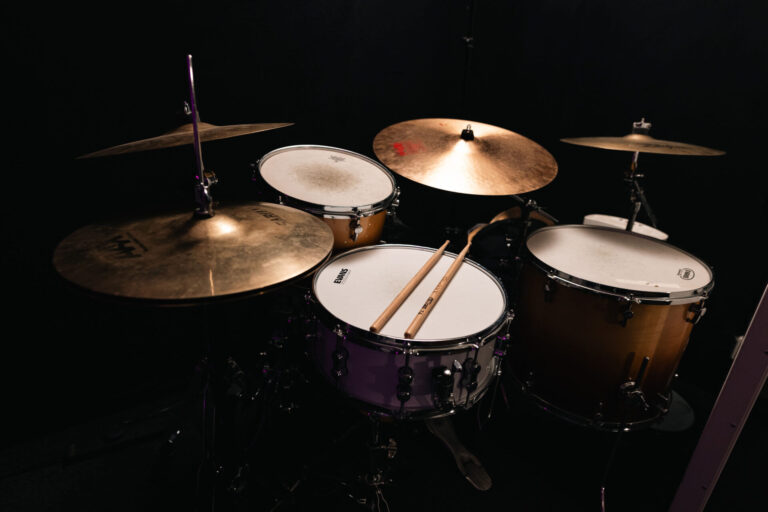
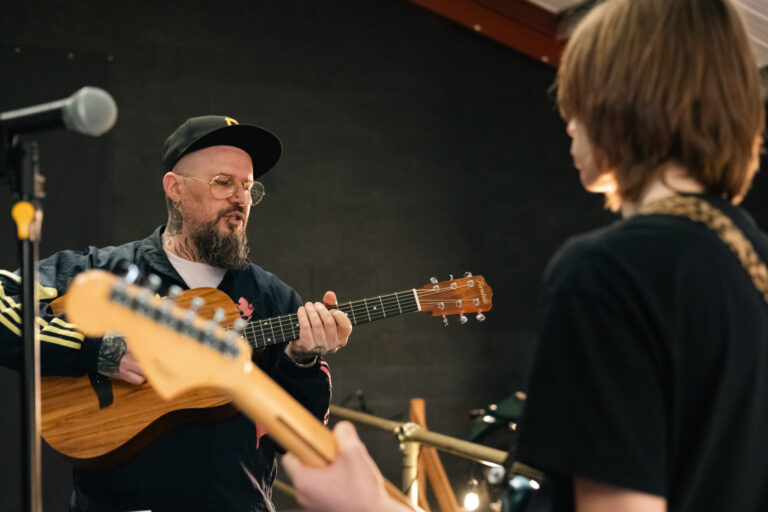
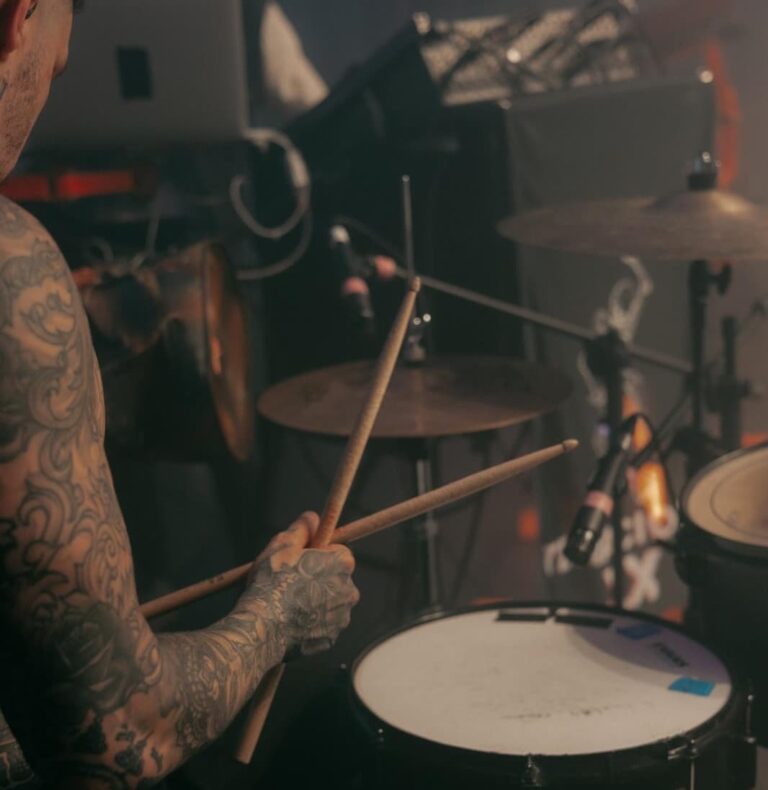
We’re not talking about sticking on a calming Spotify playlist. We’re talking about actively learning to play an instrument — getting behind a drum kit, picking up a guitar, learning rhythms, and working through songs they love.
When a child with ADHD starts learning an instrument, something pretty amazing happens in their brain. Research shows that music training can improve focus, impulse control, and self-regulation — some of the very things children with ADHD find hardest.
A landmark study published in Frontiers in Psychology found that just three months of orchestral music training produced significant improvements in inhibitory control and measurable reductions in hyperactivity in school-age children. Meanwhile, research in the Journal of Music Therapy showed that active music therapy — actually playing instruments, not just listening — reduced inattention and impulsivity in children with behavioural difficulties over a 15-week programme.
Why does it work? Because music strengthens the exact brain areas ADHD affects: attention control, working memory, and emotional regulation.
Why Drumming Is Especially Powerful
Here is something we love telling parents — not all instruments are equal when it comes to ADHD, and drumming sits right at the top.
Drumming and rhythm-based instruments are especially effective because they engage the brain’s timing and motor-planning systems — areas that research shows are disrupted in ADHD. When your child plays drums, they are doing something incredibly complex without even realising it: coordinating all four limbs independently, counting time, listening, processing patterns, and making split-second decisions about what comes next.
That kind of multi-tasking is exactly what the ADHD brain finds tricky, and exactly what it needs to practise.
Research from the Karolinska Institutet in Sweden found that rhythm-keeping ability is directly linked to the structure of the prefrontal cortex — the part of the brain responsible for planning, focus, and impulse control. For children with ADHD, this area is often underactive. Drum lessons give it a proper workout.
Further neuroscience research has confirmed that children with ADHD show specific deficits in beat synchronisation — their brains struggle to lock into a steady rhythm. Drumming targets this exact weakness, helping to train the timing circuits that ADHD disrupts. And here is what parents tell us they notice most: their child is calm after a lesson. Not wired, not overstimulated — just settled. That is backed up by science too. A rigorous clinical trial published in PLOS ONE found that a 10-week group drumming programme significantly reduced anxiety and depression, and even produced measurable changes in the body’s immune response. Real, biological calming effects.
The Research Behind the Headlines
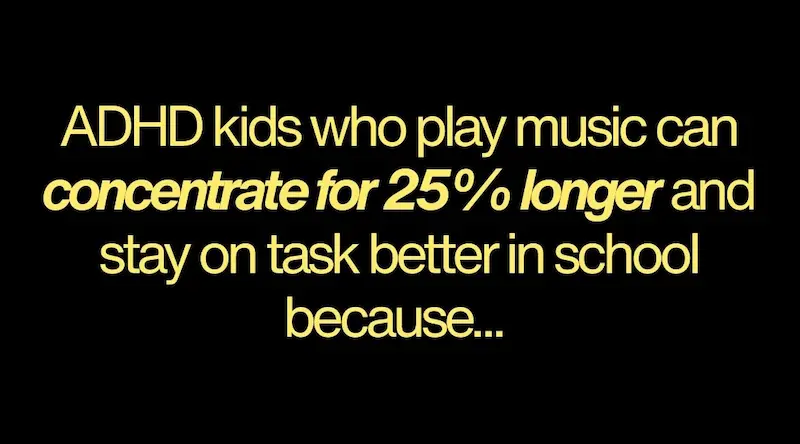
There is a reason the idea that music lessons help children with ADHD concentrate longer keeps doing the rounds — parents and teachers see it happen. The research behind the general principle is strong, even if a single definitive percentage figure is hard to pin down to one source.
A study in Psychological Science showed that just 20 days of music training improved executive function — specifically inhibitory control — in young children. Research on Interactive Metronome training found that children with ADHD showed significant improvements in attention, motor control, reading, and language processing. And a 2.5-year longitudinal study of 147 primary school children found that structured music education significantly improved executive functions including planning, inhibition, and verbal fluency.
Think about what improved attention and self-regulation means across a whole school day. More time completing tasks. Fewer interruptions. Less frustration for your child and their teachers. Better feedback at parents’ evening.
For a child who has spent years being told to sit still and pay attention, discovering something that actually helps them do that — while having an absolute blast — can genuinely change things.
Why It Works: The Science Bit, Made Simple
ADHD affects the brain’s executive functions — basically the mental processes that help us plan, focus, remember instructions, and juggle tasks. In ADHD, those processes need extra support. The good news is that music training targets them directly.
Brain imaging research involving 232 children found that music training is associated with accelerated development of the exact cortical areas that govern executive function, motor planning, and emotional regulation — regions that substantially overlap with those identified as underdeveloped in ADHD.
Learning music demands every single one of those skills, all at once. Reading ahead while playing the current bar is working memory — and a longitudinal study of 352 children found that hours of music practice directly predicted improvements in working memory over two years. Keeping time is sustained attention. Waiting for your cue is impulse control. Adjusting your volume to match others is self-monitoring. Practising a tricky section over and over until you nail it is frustration tolerance and perseverance.
Research from Harvard and MIT confirmed that musically trained children show enhanced performance on executive function tasks and greater activation in prefrontal brain areas — the primary site of dysfunction in ADHD.
Your child is not doing brain training. They are playing a song they love. The cognitive benefits just happen to come along for the ride.
What Parents Tell Us
Mesut brought his special needs son in for an introductory session and said the staff were lovely and accommodating and the place brilliantly designed. Jodie shared that her autistic daughter, who struggles with communication and has situational mutism, has been thriving with her tutor Josh. As she put it:
“We really cannot thank you enough for your patience with her.”
Philippa, a drumming student and parent herself, highlighted how inclusive and supportive the approach to learning is — something she experiences in her own lessons and sees in her son’s. And Julia told us how her shy youngest son found the confidence to perform at the annual showcase:
“This is a true testament to all involved at Top of the Rock as he was in a safe space and felt confident enough to do it.”
These are not one-off stories. They are the pattern. When a child finds something they are good at — something that works with their brain instead of against it — everything shifts. Their confidence grows. They are more willing to try hard things. They start to see themselves differently.
And that matters just as much as the science.
Guitar, Drums, or Something Else?
While drumming gets the most research attention for ADHD, it is far from the only option. Here is how different instruments can help.
Drums
The strongest evidence for ADHD benefits. Full-body coordination, rhythm, and immediate physical feedback make drums ideal for children who need to move. The structured repetition of beat patterns is naturally grounding. Find out more about drum lessons in Leeds.
Guitar
Brilliant for building fine motor control and patience. Learning chord changes takes sustained focus and rewards persistence. Loads of children with ADHD love guitar because progress feels real — you learn a chord, then a song, then you are playing something your mates recognise. Find out more about guitar lessons in Warwick.
Piano and Keyboard
Great for working memory and coordination. Research shows that just 15 months of instrumental music training produces measurable structural brain changes in children — and reading two lines of music while coordinating both hands is a seriously good brain workout. Find out more about piano lessons in Stratford-upon-Avon.
Bass
Often overlooked, but fantastic for ADHD. The bass player’s job is to lock in with the drummer and hold the groove — it teaches listening, patience, and the ability to serve the music rather than dominate it.
The best instrument for your child is the one they are excited about. Motivation is half the battle with ADHD, and if they are genuinely keen to learn, the benefits follow naturally.
Finding the Right Environment
Not all music lessons are the same, and the right setting makes a real difference. Here is what we would suggest looking for.
Structured but flexible teaching
Children with ADHD thrive when they know what is coming next. But the best tutors also know when to go off-script if a child is properly locked into something.
Patient, understanding tutors
ADHD brains work differently, and that is not a problem to fix — it is something to work with. You want tutors who understand that a child might need to move, fidget, or take a completely different route through a lesson, and are absolutely fine with that.
Regular wins along the way
Progress needs to feel achievable. Great tutors break things down so your child gets those moments of genuine triumph regularly, not just distant goals that feel impossible.
A proper studio space
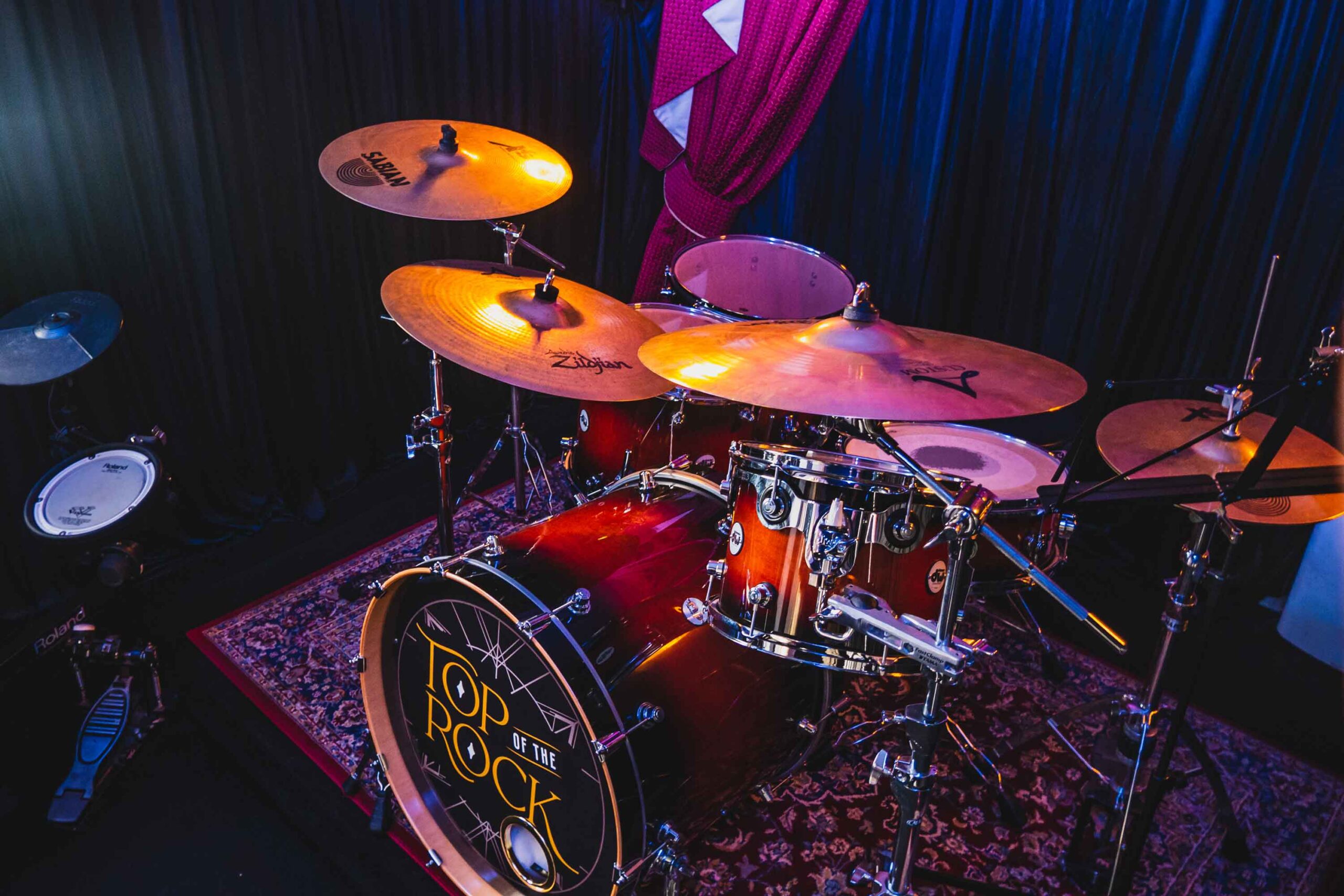
Fewer distractions, professional kit, and a space that feels special rather than another classroom. That separation from school helps children see music as something different. Something that is theirs.
At Top of the Rock, our studios in Leeds, Warwick, and Stratford-upon-Avon are built for exactly this kind of learning. We work with children of all abilities and all ages, and we understand that every child learns differently. We put every pupil’s experience above all else — because that’s what gets results.
As Bradley Banister, Head of Music at Aylesford School, put it in his five-star review:
“We are all so grateful to be working with Top of the Rock who have not only brought this to so many of our students, but who go above and beyond to ensure each student gets a personalized, fun and educational experience.”
It Is Not a Replacement. It Is a Powerful Addition.
Worth saying clearly: music lessons are not a replacement for medical advice, therapy, or medication if that is what your child needs. Current NHS and NICE guidelines recommend behavioural therapy and medication as first-line treatments for ADHD, and we would always encourage you to follow your doctor’s advice.
But music is an incredibly effective addition to those things. A World Health Organisation review of over 3,000 studies acknowledged music’s positive effects on cognitive development, attention, and self-regulation in children. And a meta-analysis in the Journal of Child Psychology and Psychiatry found a clinically meaningful overall effect for music therapy with children with behavioural and developmental conditions.
What music gives a child with ADHD is something that works with their wiring. Something that channels their energy rather than trying to shut it down. Something that builds the exact skills they find hardest — in an environment where they are having fun, growing in confidence, and creating something they are genuinely proud of.
If your child has ADHD and you have been looking for something that might make a real difference — the research backs this up. Doctors are recommending it as a complementary support. And the children? They absolutely love it.
So Why Not Give It a Go?
We offer free taster sessions at all of our studios so your child can try an instrument and see how they feel. No pressure, no commitment — just a chance to see if music clicks for them.
No matter your child’s age, background, or experience — we’re here to help them find their thing. Book a free taster session or get in touch to chat about which instrument might be the perfect fit.
Top of the Rock Tuition — Studios in Leeds, Warwick, and Stratford-upon-Avon. Private music lessons for all ages and abilities.
References
- Slater J, Kraus N et al. (2019). Beyond self-report: comparing questionnaire and neural measures of music training. Frontiers in Psychology, 10, 750. https://doi.org/10.3389/fpsyg.2019.00750
- Corrigall KA, Schellenberg EG. (2015). Predicting who takes music lessons. PLOS ONE. https://doi.org/10.1371/journal.pone.0151136
- National Institute for Health and Care Excellence (2018, updated 2023). Attention deficit hyperactivity disorder: diagnosis and management. NICE guideline NG87. https://www.nice.org.uk/guidance/ng87
- World Health Organization Regional Office for Europe (2019). What is the evidence on the role of the arts in improving health and wellbeing? A scoping review. https://www.who.int/europe/publications/i/item/9789289054553
- Rickard NS, Bambrick CJ, Gill A. (2012). Absence of widespread psychosocial and cognitive effects of school-based music instruction in 10-13-year-old students. International Journal of Music Education, 30(1), 57-78.
https://journals.sagepub.com/doi/abs/10.1177/0255761411431399 - Schlaug G, Norton A, Overy K, Winner E. (2006). Effects of music training on the child’s brain and cognitive development. Annals of the New York Academy of Sciences, 1060, 219-230.
https://doi.org/10.1196/annals.1360.015 - Tierney AT, Kraus N. (2008). The ability to move to a beat is linked to the consistency of neural responses to sound. Journal of Neuroscience, 33(38), 14981-14988. https://doi.org/10.1523/JNEUROSCI.0825-08.2008
- Grahn JA, Brett M. (2009). Impairment of beat-based rhythm discrimination in Parkinson’s disease. Cortex, 45(1), 54-61.
https://doi.org/10.1038/s41598-017-11295-w - Schellenberg EG. (2011). Examining the association between music lessons and intelligence. British Journal of Psychology, 102(3), 283-302. https://doi.org/10.1177/0956797611416999
- Shaffer RJ, Jacokes LE, Cassily JF et al. (2001). Effect of Interactive Metronome training on children with ADHD. American Journal of Occupational Therapy, 55(2), 155-162. https://doi.org/10.5014/ajot.55.2.155
- Moreno S, Bialystok E, Barac R et al. (2011). Short-term music training enhances verbal intelligence and executive function. Psychological Science, 22(11), 1425-1433.
https://pubmed.ncbi.nlm.nih.gov/21969312/ - Tierney A, Strait DL, O’Connell S, Kraus N. (2013). Developmental changes in auditory subcortical responses to real speech. Frontiers in Human Neuroscience, 7.
https://www.frontiersin.org/journals/human-neuroscience/articles/10.3389/fnhum.2013.00926/full - Habibi A, Cahn BR, Damasio A, Damasio H. (2016). Neural correlates of accelerated auditory processing in children engaged in music training. Developmental Cognitive Neuroscience, 21, 1-14.
https://www.sciencedirect.com/science/article/pii/S1878929315301122 - Chobert J, Marie C, Francois C et al. (2014). Enhanced musical rhythmic abilities in dyslexic children. Brain and Language, 120(2), 99-107. https://doi.org/10.1371/journal.pone.0099868
- Hyde KL, Lerch J, Norton A et al. (2009). Musical training shapes structural brain development. Journal of Neuroscience, 29(10), 3019-3025. https://doi.org/10.1523/JNEUROSCI.5118-08.2009
- Gold C, Wigram T, Elefant C. (2022). Music therapy for autistic spectrum disorder. Cochrane Database of Systematic Reviews.
https://www.cochranelibrary.com/cdsr/doi/10.1002/14651858.CD004381.pub4